Mobile field workflow
Jobworks
Keep the task familiar in the field.
A field-service platform for quotes, invoices and crew workflows, currently in internal alpha with the development team.
My contribution. The founder originated Jobworks and invited me as CTO. I own product decisions around modularity, approachable onboarding and capture direction, working with the team and AI coding tools.
- My role
- Co-founder & CTO · Product direction & AI-assisted development
- Period
- 2026–ongoing
- Built with
- Next.js · React Native / Expo · tRPC · PostgreSQL · SQLite
Use the conventions people already know.
In internal testing, I found our capture feature unfamiliar and unintuitive. The Jobworks design system was not yet suited to a camera interface.
I directed the flow toward native iOS camera conventions, preserving zoom and camera switching while adding job assignment, queuing and bulk uploads. On retest, I could take photos and assign a job without the menu friction I had noticed.
What the recording actually shows.
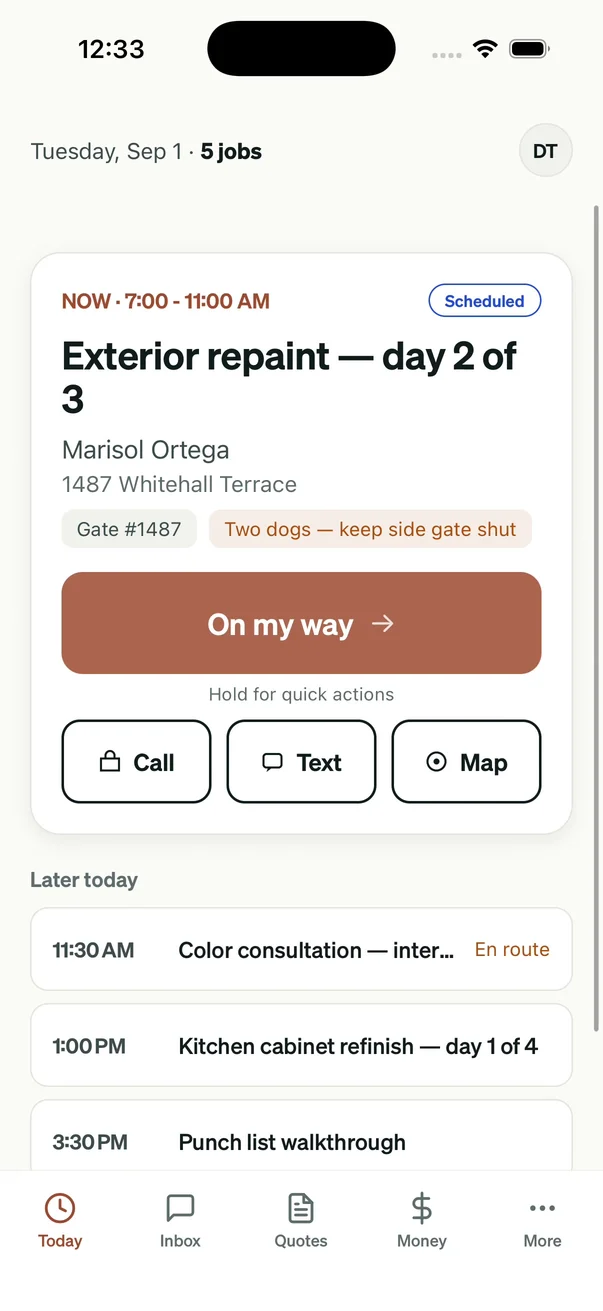
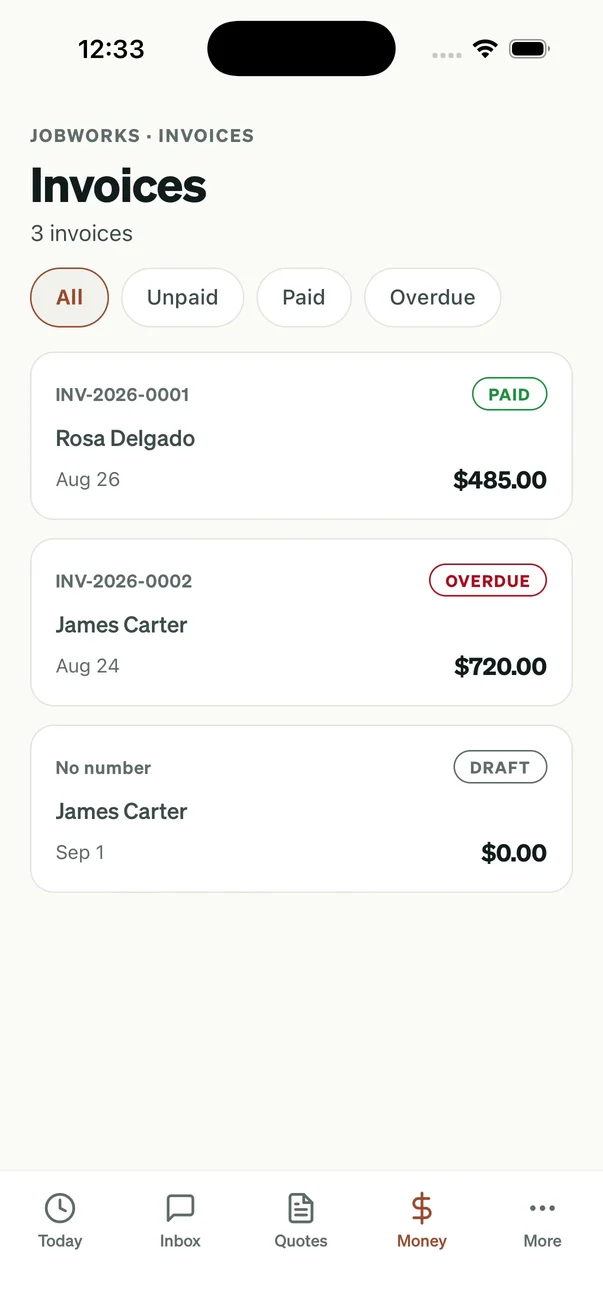
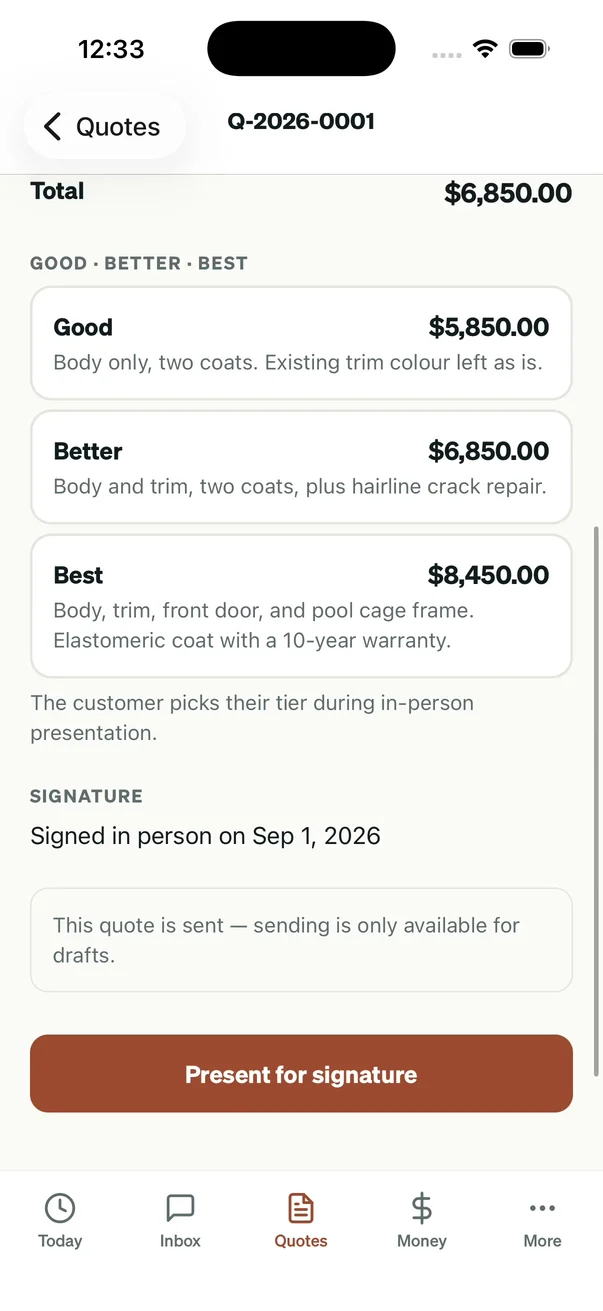
The genuine iOS recording below shows Today, a quick-action gesture, invoices with undo, quote tiers and an AI reply draft. All names, addresses, amounts and messages are fictional fixtures.
It does not show the capture redesign. That decision is supported here by my internal-test account; a recording of the camera and recovery sequence is still the next evidence milestone.
Put the next field action in reach.
The Today frame makes On my way dominant, with Call, Text and Map nearby. Later jobs remain visible below it. The quick-action gesture is an additional route; the visible buttons keep the core actions discoverable.
These are observations of the recorded interface, not evidence of faster task completion or contractor adoption.
Recovery needs a visible state.
The inspected capture implementation includes discard protection, job selection and feedback for locally saved work and upload retry. The camera helper invokes the platform camera API.
Those source paths explain how the intended flow handles interruption. They do not establish that the recording above contains that build or that another person successfully recovered an upload.
Default review, explicit automation.
AI replies default to drafts for review. The inspected implementation also supports explicitly enabled auto-send; live settings and use have not been verified.
The fixture recording shows a suggested reply with Send and Edit. It demonstrates the review interface, not a guarantee that every possible reply is manually approved.
Internal learning before customer claims.
Jobworks is an internal alpha/closed beta between the development team and me. Paintworks and external customers have not used it.
My capture-flow improvement is a subjective observation from internal iOS testing, without measured latency, an external usability study or customer results.
Outcome & next test
During internal iOS testing, I found the revised capture flow easier to understand and use. This is my qualitative observation; Paintworks and external customers have not used Jobworks.
The next evidence milestone is a current device recording of job selection, camera capture, queued attachment and a recovery state, followed by testing with a contractor.
Have a project in mind?
I’m open to product engineering roles and contract work.